How ABA therapy supports menstrual hygiene in autism
Menstrual hygiene in autism can feel easier with visual steps, sensory-friendly products, and ABA practice. Learn how we can support your child.

How ABA therapy supports menstrual hygiene in autism
Key points:
- Support with menstrual hygiene in autism works best when period care is taught through small, predictable steps before the first cycle.
- Visual schedules, sensory-friendly products, task analysis, and repeated practice can build independence with pad changing and bathroom routines.
- Medical symptoms such as severe pain or heavy bleeding require healthcare evaluation.
Teaching menstrual hygiene for children with autism can feel more manageable when the routine is broken into small steps. In our ABA programs at Total Care, we can support daily self-care goals with visual cues, step-by-step practice, and caregiver coaching based on your child’s current abilities.
Starting early can make new routines more familiar before your child has to manage menstruation for the first time. This guide explains when to begin, how task analysis works, how sensory needs can affect product choice, and how practice at home can support independence.

Start period preparation before the first menstrual cycle
Preparation can begin before the first period. Research on autism and menstruation experiences shows that early information and practical preparation can help autistic young people better understand what to expect.
Early teaching can make autism and menstruation more predictable because your child can learn what a period is, what menstrual blood may look like, where supplies are kept, and whom to ask for help.
We can start with prerequisite skills instead of expecting your child to complete the whole routine at once. This keeps the focus on practical period care while recognizing that autism and puberty can bring new self-care expectations.
Your child may practice how to:
- Recognize clean and used menstrual products.
- Open a pad package.
- Place a clean pad on underwear.
- Pull clothing up and down.
- Follow a bathroom visual.
- Wash and dry their hands.
- Ask a trusted adult for help.
How ABA supports menstrual hygiene for children with autism
Task analysis means breaking a complex task into individual actions. A period routine involves several steps that need to happen in a certain order, so teaching the whole process at once may be difficult.
In our sessions, we can teach one action at a time and connect the steps as your child becomes more comfortable with the routine. We may use prompts and positive reinforcement, then reduce help as your child becomes more independent.
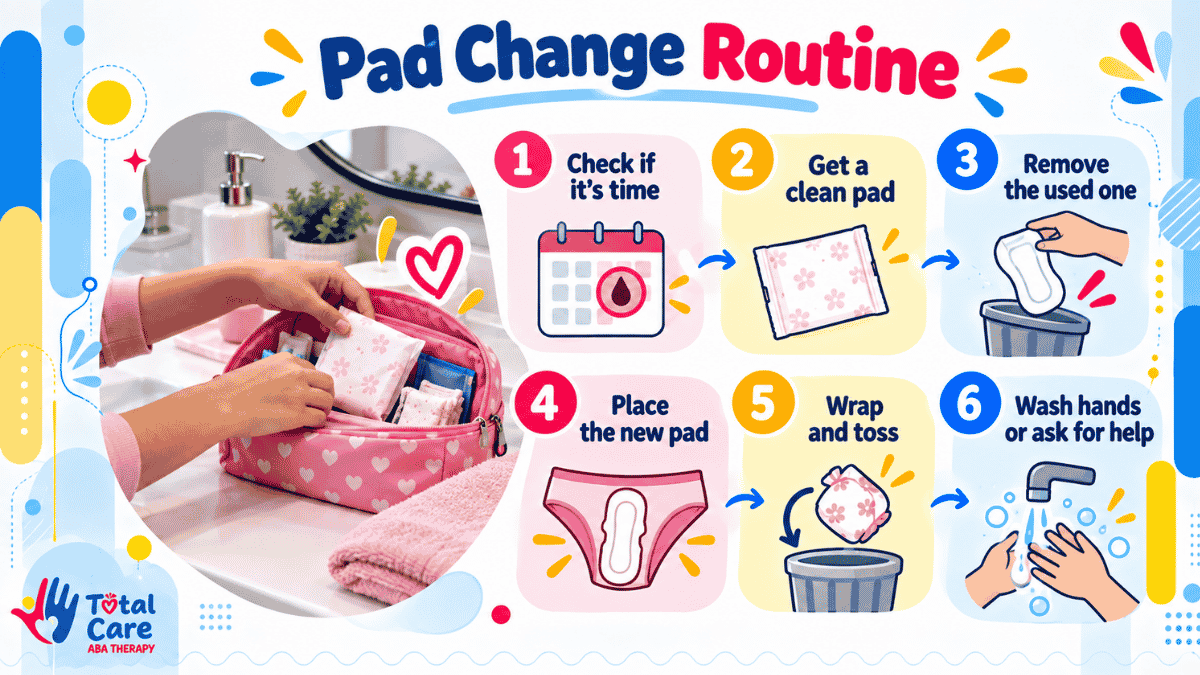
A typical autism puberty hygiene routine might include:
- Notice that a pad change is needed
- Get a clean pad
- Remove the used pad carefully
- Place the clean pad securely on underwear
- Wrap and dispose of the used product
- Clean up and get dressed
- Wash and dry hands
- Ask for help when needed
The exact steps should match your child’s communication skills, motor abilities, privacy needs, and current level of independence.
Use visual teaching before expecting independent period care
Spoken directions can be difficult to remember when a child is also processing new sensations and several bathroom steps. Visual tools stay available throughout the routine and give your child something to refer back to.
Use autism-friendly visual steps for menstrual hygiene
Visual cues can turn an unfamiliar routine into a sequence your child can see and follow. Depending on your child’s needs, you can try:
- Picture schedules near the bathroom
- Numbered step cards showing product placement
- Short video models showing the routine
- An autism period social story explaining what to expect
A 2024 study on video modeling and menstrual hygiene found that autistic adolescents improved their menstrual hygiene skills after video modeling and hands-on simulation.
Puberty visual supports for autism can also be added to an existing bathroom routine before your child needs to manage a period independently. Keep the visuals simple and choose pictures or wording your child already understands.
Choose period products based on sensory needs and skill level
Product refusal can be related to how an item feels, smells, fits, or moves. Your child may understand why a menstrual product is needed and still dislike the sensation of wearing it.
Caregivers can watch for reactions to:
- Texture against the skin
- Wetness
- Thickness
- Adhesive or bunching
- Smell
- Tightness
- Number of steps required
- Whether the product goes inside or outside the body
A study of menstrual product preferences among autistic youth found that sensory impact was an important consideration for caregivers. Period underwear was the most preferred option among the young people in the study.
No single product works best for every child. We can help identify which parts of the routine are difficult and teach the skills needed around the product your family chooses.
Practice the routine at home and prepare for school
Consistent practice can help your child use new skills in different settings. Through our ABA parent training, our Board Certified Behavior Analysts (BCBAs) can model techniques, coach you as you practice them, and help connect home routines with treatment goals.
You can support learning at home by:
- Keeping clean products in the same accessible place
- Practicing how to open and place clean pads during calm moments
- Using short, consistent wording for prompts
- Noting which steps your child completes without help
- Gradually reducing prompts as independence grows
For children receiving home-based ABA therapy, self-care skills may also be practiced in the environment where the routine normally happens when the goal is appropriate for the treatment plan.
School preparation also deserves attention. Your family can decide which staff member your child feels comfortable approaching, where to store extra products, and how your child can discreetly ask for a bathroom break or help.
When school-based support is part of your child’s plan, our in-school ABA therapy services can include coordination around functional routines and communication goals.
Keep medical period concerns separate from ABA skill training
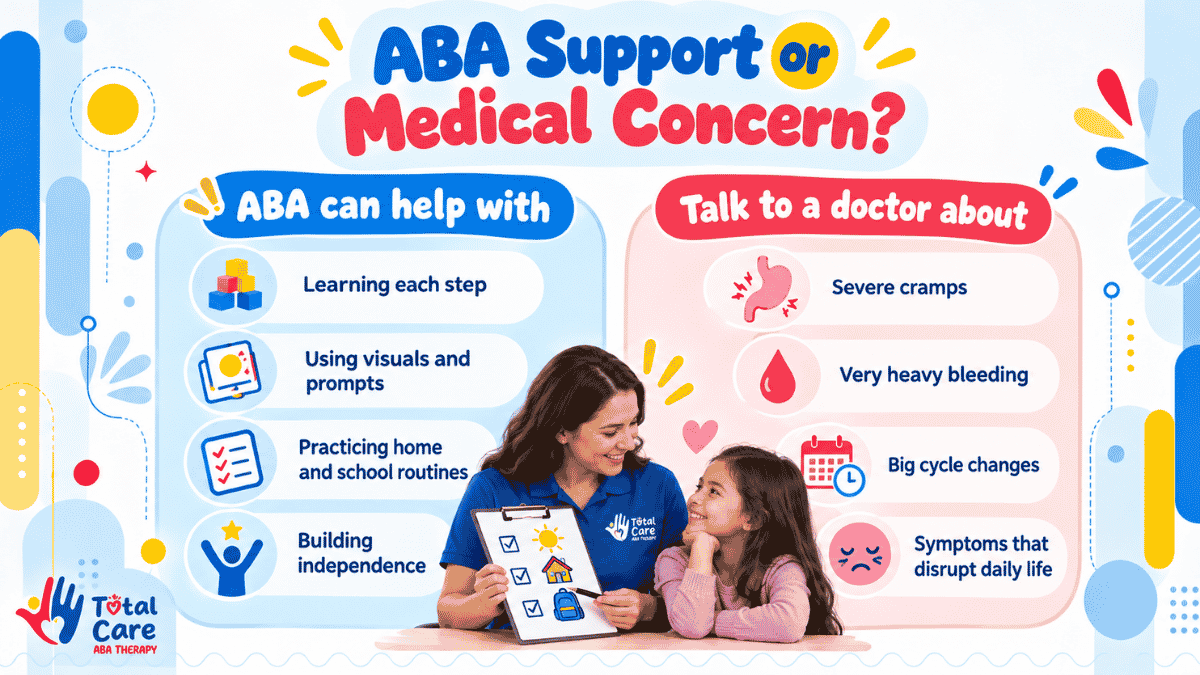
ABA therapy can help teach daily routines, communication, and self-care skills. It does not diagnose or treat menstrual disorders.
Severe cramps, unusually heavy bleeding, major changes in a menstrual cycle, or symptoms that interfere with daily activities should be discussed with a healthcare professional.
The American Academy of Pediatrics provides guidance on menstrual concerns in adolescents, including signs that may need medical evaluation.
A pediatrician, adolescent medicine specialist, or gynecologist can assess physical symptoms. Our role is to focus on functional skills, communication, and greater independence when those goals are appropriate for your child’s ABA treatment plan.
FAQs about menstrual hygiene and autism
Can ABA help my child learn to change a pad independently?
Yes, when the goal is appropriate for your child’s treatment plan. We can break pad changing into smaller steps, teach each action, and gradually reduce prompts as your child completes more of the routine independently.
Progress may begin with one step, such as opening a wrapper or placing a clean pad correctly, before moving on to the full sequence.
What if my child refuses to wear a pad?
Start by looking at possible sensory concerns such as texture, wetness, thickness, smell, or how the product feels against the skin. Trying options such as thinner pads or period underwear may help you find a product your child tolerates better.
Pain or other physical symptoms should be discussed with your child’s healthcare provider.
Should we practice menstrual hygiene before my child gets their first period?
Yes. Practicing with clean supplies before menstruation begins can help your child learn bathroom steps, become familiar with products, use visual schedules, and practice asking for help before they need these skills during an actual period.
Talk with our team about your child’s next self-care goal
Menstrual care involves several self-care skills that may take time and practice to learn. Breaking the routine into smaller steps, using visual supports, considering sensory needs, and practicing consistently can help your child become more involved in their own care.
If menstrual hygiene is becoming a self-care goal for your child, talk with our team at Total Care ABA. We can discuss your child’s needs and whether this goal can be included in their ABA treatment plan.