
Does Tylenol cause autism at any dose?
The Tylenol autism link has no proven causal dose. Research findings explain why study methods affect the results.

Does Tylenol cause autism at any dose?
Key Points:
- The Tylenol autism link remains unproven, including claims about a dose that causes autism.
- Studies comparing siblings have not found increased autism risk from prenatal acetaminophen exposure, although medication records have limits.
- Research about exposure before birth cannot automatically explain the effects of medicine given to children after birth.
Research has not established that Tylenol causes autism at any particular dose. Some studies found a connection between acetaminophen use during pregnancy and later autism diagnoses. Larger studies that account for family differences have not found the same connection.
Tylenol contains acetaminophen, a medicine used for pain and fever. Headlines about the Tylenol autism link can leave parents wondering whether a past medication choice harmed their child. The research cannot draw that conclusion from a history of taking the medicine.

What studies found about the Tylenol autism link
Studies have reported different findings because researchers measure medication exposure and account for other influences in different ways.
Why earlier studies raised concerns
A 2019 study of umbilical cord blood examined 996 mother-child pairs. Researchers measured acetaminophen and substances the body produces when it breaks down the medicine.
Children with higher measured levels had greater odds of receiving an autism diagnosis later. That finding showed an association, meaning two things occurred together. It did not prove that acetaminophen caused autism or identify a dose that would cause it.
What larger studies and newer reviews added
A 2024 study involving nearly 2.5 million children in Sweden initially found a small association between prenatal acetaminophen exposure and autism. The association disappeared when researchers compared siblings within the same families.
Those sibling comparisons also found no pattern linking higher recorded exposure to higher autism risk.
Two research reviews added further context:
- A 2026 review of 43 studies, with 17 included in its combined statistical analysis, found no autism association in sibling comparisons or studies with a low risk of bias. Bias means a study’s methods may affect its findings.
- Another 2026 review of seven earlier research analyses found that associations weakened when researchers focused on higher-quality evidence. Its authors concluded that the available evidence did not support a causal relationship.
These reviews reassessed existing studies. Their participant totals do not represent entirely new groups of children.
Why a research link does not prove cause
An association tells researchers that two things occur together. Other factors may explain the connection.
For example, a pregnant person might take acetaminophen because of an infection or fever. Researchers must consider the illness, other medicines, and family health before deciding whether acetaminophen explains an outcome. These influences can affect results even when a study includes many participants.
Sibling comparisons help account for some shared genes and family circumstances. They reduce certain differences between families, but they cannot remove every uncertainty. Medication records may also miss nonprescription use or lack details about when someone took the medicine.
Has research found an amount of Tylenol that causes autism?
Researchers have not identified an amount of Tylenol that causes autism. The question “how much Tylenol causes autism?” assumes a cause-and-effect relationship that the evidence has not established.
Some studies reported stronger associations with longer use or higher measured exposure. Those patterns alone cannot prove causation. The Swedish sibling study found no dose-related increase in autism risk, but its records could not fully capture every dose, timing, or pattern of use.
The findings do not establish a medication safety limit. A study about autism cannot tell an individual how much medicine to take.

How health authorities interpret pregnancy research
Health authorities have issued different statements about prenatal acetaminophen exposure. A warning about a possible association does not mean researchers have proven a cause.
In September 2025, the FDA announced plans to change acetaminophen labeling because of a possible association with autism and ADHD. The announcement also acknowledged that causation had not been established and that other studies reported contrary findings.
The American College of Obstetricians and Gynecologists stated that the weight of evidence does not support a causal link. Questions about medication during a current pregnancy belong with a healthcare professional who knows the person’s health history.
Does giving Tylenol to a child cause autism?
Research has not established that giving a child Tylenol after birth causes autism. The major pregnancy studies discussed above examine exposure before birth, so their findings cannot automatically answer questions about childhood medication use.
A study combining six European birth cohorts examined both prenatal exposure and acetaminophen given during early childhood. It found no association between exposure after birth and autism-related symptoms. That result concerns the exposure and outcomes studied; it does not answer every question about childhood use.
A parent may remember giving Tylenol before their child received an autism diagnosis. That sequence alone cannot show that the medicine caused autism.
How parents can address developmental concerns
Concerns about a child’s communication, play, learning, or behavior deserve attention regardless of past medication use. A pediatrician can discuss those observations and consider developmental screening or further evaluation.
For example, a child might rarely respond when called or have difficulty communicating what they want. These observations do not establish an autism diagnosis, but specific examples help the pediatrician understand the concern.
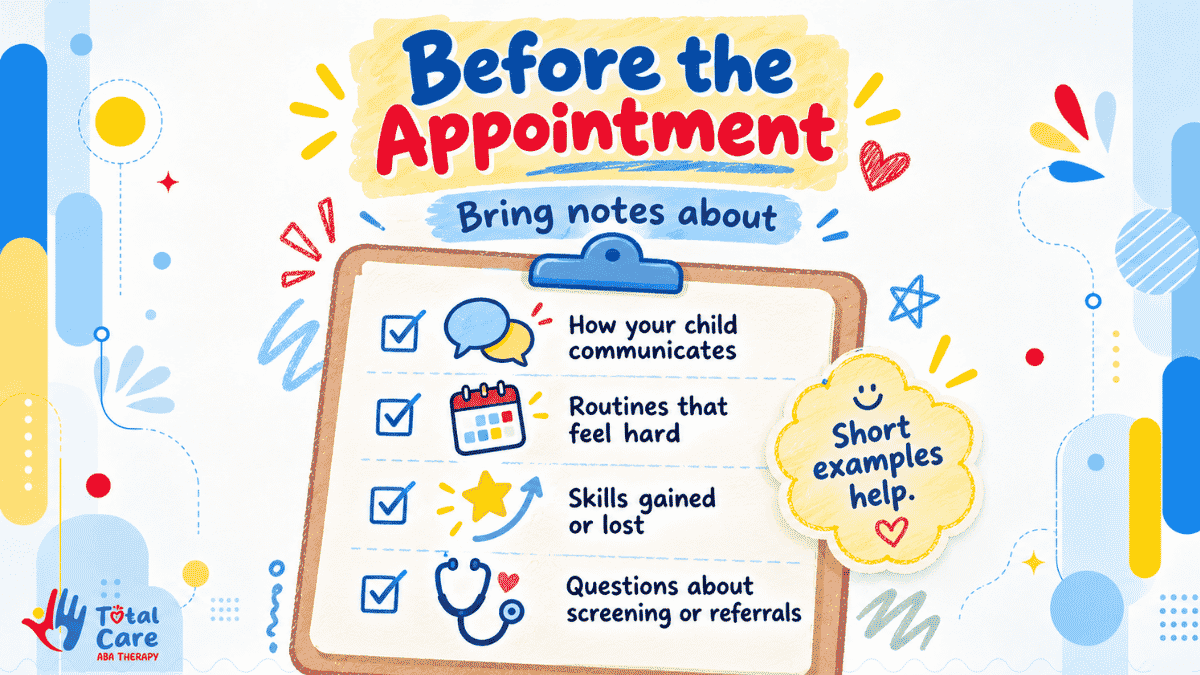
Appointment notes can include:
- How the child communicates needs at home.
- Activities or routines that cause difficulty.
- Skills the child has learned or stopped using.
- Questions about screening and referrals.
How we plan ABA support after a diagnosis
For children with an autism diagnosis whose families are exploring applied behavior analysis, or ABA, we offer initial ABA assessments. At Total Care ABA, our Board Certified Behavior Analysts, or BCBAs, review existing evaluations, observe the child’s skills, and talk with caregivers about routines and goals.
We use those findings to develop an individualized treatment plan. An ABA assessment plans therapy; it does not diagnose autism or determine its cause.
Support may include:
- Home-based ABA therapy: We practice treatment goals during familiar activities. For example, a child might work on requesting a snack in the kitchen.
- ABA parent training: Our BCBAs demonstrate strategies and help caregivers practice them. Our examples of parent coaching during daily routines show how practice can connect with meals, play, and bedtime.
- School support: We collaborate with teachers and educators to support the child’s needs at school.
FAQs about the Tylenol autism link
Why do some studies use the name paracetamol?
Paracetamol is another name for acetaminophen, the ingredient in Tylenol. Research papers may use either name because they examine the ingredient across medications, rather than one brand alone.
Does research show that Tylenol causes ADHD?
Research has not established that prenatal acetaminophen exposure causes attention-deficit/hyperactivity disorder, or ADHD. The 2024 Swedish sibling study found no increased ADHD risk, and the 2026 review found no association in its sibling comparisons.
Can an autism diagnosis identify what caused it?
An autism diagnosis identifies a developmental condition; it usually does not identify one cause. Autism can involve genetic, biological, and environmental factors, and researchers still have questions about how those factors interact.
Find support for your child’s everyday needs
Questions about past Tylenol use may remain on a parent’s mind. The evidence does not establish a causal dose, and a child’s communication and daily support needs can receive attention while research continues.
At Total Care ABA, we help families explore individualized care based on their child’s assessment and goals. Our ABA therapy services include home-based support, parent training, and collaboration with educators. Families considering therapy can learn what each service involves before taking the next step.