Weighted vest for autism: Does it help and is it safe?
A weighted vest for autism has limited research support. Learn what studies show and which safety checks come first.

Weighted vest for autism: Does it help and is it safe?
Key Points:
- A weighted vest for autism has not earned consistent research support for improving attention or everyday participation.
- Findings about massage, blankets, or other pressure-based tools cannot establish the benefits of a vest.
- Decisions should start with a sensory assessment and include the child’s preferences, safety needs, and response during specific activities.
A weighted vest for autism adds pressure around the upper body. Some children enjoy that feeling, but research has not consistently shown that weighted vests improve attention, calmness, or everyday activities. Other children may find the weight uncomfortable.
An occupational therapist (OT) can assess sensory concerns and help families decide whether a vest deserves consideration. A child’s comfort and preferences should guide that discussion, along with the available research.

What is a weighted vest for autism?
A weighted vest looks like regular clothing but contains weights across the front, back, or both. The garment provides pressure against the body, often called deep-pressure input.
Children experience that pressure differently. One child may enjoy a firm hug or snug clothing, while another dislikes anything heavy against their body. Even a child who enjoys one type of pressure may dislike a weighted vest.
Enjoying the sensation also differs from showing an improvement in an activity, such as drawing, eating, or playing with others.
Do weighted vests help children with autism?
Studies have produced mixed results. A systematic review of weighted vests and autism found that the research did not meet standards for an evidence-based practice. In everyday terms, the studies did not provide enough dependable evidence to recommend weighted vests as an established autism intervention.
What research says about focus and attention
A classroom study involving 10 autistic children found less off-task behavior in some participants, but the results varied. The vest did not improve sitting in the children assessed for that outcome. Positive impressions from classroom aides also exceeded the improvements researchers measured.
These findings help explain why families may hear different reports. An adult’s impression that a child seems calmer does not necessarily match a measured change in attention or participation.
Why research on other pressure-based tools does not prove that vests work
A 2025 review of sensory-based interventions found encouraging results for some deep-pressure approaches, including certain massage and weighted-blanket interventions. Its included ball-filled vest study, involving children with sensory-seeking behavior, did not find significant improvements in attention, body awareness, coping, or learning.
Blankets, massage, and weighted vests apply pressure differently. Their studies also involve different children and goals. Findings about one method cannot establish that another will prevent meltdowns or improve concentration.
When should families speak with an occupational therapist?
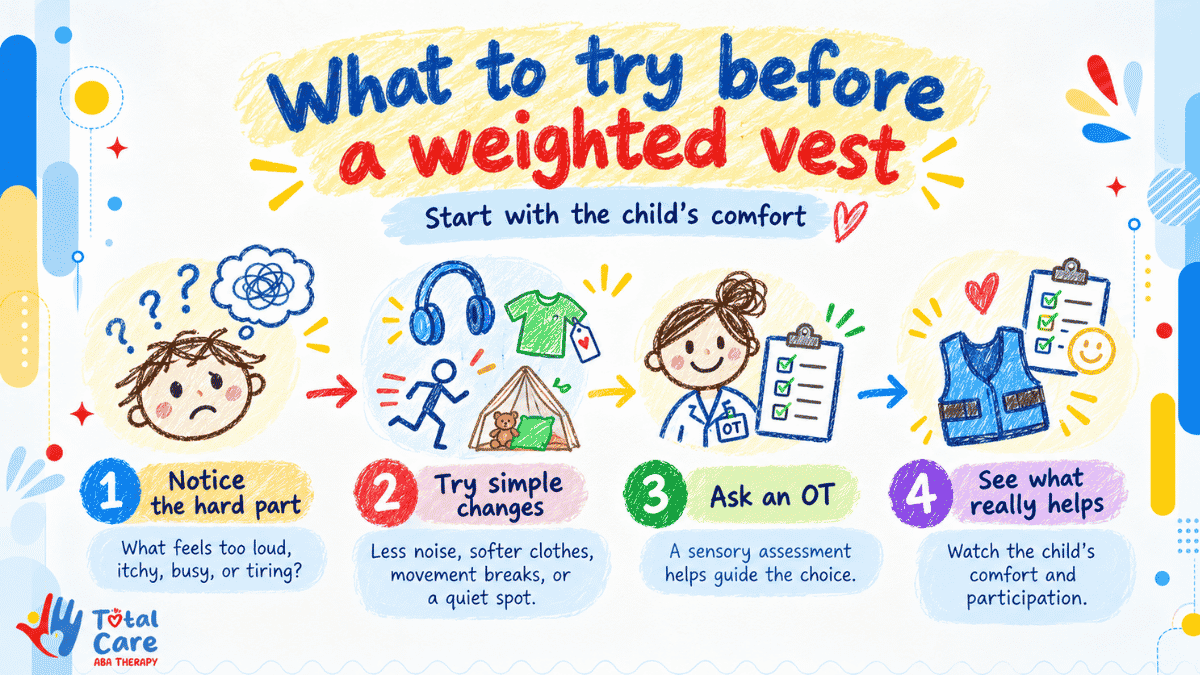
Sensory experiences deserve attention when they interfere with activities a child wants or needs to do. Examples include clothing that feels painful or a noisy room that makes eating difficult.
The American Occupational Therapy Association recommends a documented sensory assessment before sensory-based interventions, including weighted vests. An autism diagnosis alone does not establish a need for one.
A discussion with an OT can focus on:
- The concern: What makes the activity uncomfortable or difficult?
- The goal: What would the child like to do more comfortably?
- The options: Could a change to the activity or surroundings address the problem?
For example, a child who covers their ears during lunch may need less noise. A quieter eating area addresses that concern directly without adding weight to the child’s body.
What should parents know about weighted-vest safety?
A weighted vest is not automatically safe because a retailer markets it for children. An OT should assess its suitability, including the child’s health, movement, and ability to communicate discomfort. Health concerns may also require input from the child’s doctor.
There is no single weight or wearing schedule that research establishes as appropriate for every autistic child. Online percentages and timed schedules cannot replace an individual assessment.
The College of Occupational Therapists of Ontario identifies risks from prolonged weighted-vest use, including fatigue, overheating, discomfort, and possible injury.
Safety discussions should cover:
- Breathing and movement: The garment must allow comfortable breathing and movement.
- Supervision: An adult needs to recognize problems and help remove the vest.
- Child choice: Refusal, pulling at the vest, or requests to stop deserve attention.
- Warning signs: Pain, unusual tiredness, overheating, or distress are reasons to stop.
- Purpose: A vest must never serve as punishment or hold a child in place.
A child should not have to tolerate discomfort to complete an activity. Parents should seek professional advice before changing the weight or extending wearing time.

How can parents tell whether a vest is helping?
An OT can help families choose a specific activity to observe and decide when to review the results. Notes about what actually happened provide more information than a general statement such as “the afternoon went better.”
Parents can record:
- What the child did during the activity.
- Whether the child wanted to wear the vest.
- Any signs of comfort or discomfort.
- What happened during comparable activities without it.
- Other changes, such as less noise or more adult support.
For example, a child might remove the vest during drawing and continue enjoying the activity. That observation shows participation did not depend on wearing it. It does not establish why the child wanted it removed.
At Total Care ABA, our parent training includes learning to track progress and share observations with our clinical team. Those skills support communication about daily needs; an OT should direct decisions about sensory equipment.
Other ways to support a child’s sensory needs
Sensory support can begin with the discomfort a child experiences. Families may consider everyday adjustments based on the child’s preferences:
- Noise: A quieter place for meals or homework.
- Clothing: Softer fabric or removal of an irritating tag.
- Movement: Opportunities to walk or stretch between activities.
- Rest: Access to a quiet space when the child wants a break.
These are options to consider, not promises of improvement. A child’s response helps families decide which adjustments to keep. Persistent difficulties with eating, dressing, play, or other routines deserve professional assessment.
How ABA therapy can support communication and daily routines
ABA therapy can address communication and daily living goals. An OT provides specialized assessment of sensory concerns and advice about sensory equipment.
For a child who becomes uncomfortable in a noisy room, a communication goal might involve requesting a break through speech, gestures, pictures, or a communication device. Adults also need to respond to that request and address the discomfort.
In our home-based ABA therapy, we practice individual goals during familiar activities. Our BCBAs also demonstrate strategies and coach caregivers as they practice. A family might work on a break request during play, then practice that skill in other routines.
Break requests can also support community activities. Our examples of ABA safety skills include ways children can communicate that they want to step away during an outing.
FAQs about weighted vests for autism
Are weighted vests and compression vests the same?
Weighted vests add weight, while compression vests use snug material to apply pressure. Some products combine both features. Product names can overlap, so an OT should review the actual garment before recommending it.
Can a child wear a weighted vest at school?
School use needs a plan involving the family, school team, and relevant professionals. The plan should identify the intended activity, who will supervise, removal instructions, and how staff will share observations. School procedures also apply; a recommendation for home use should not automatically become an all-day classroom routine.
Are weighted vests only used for autistic children?
Researchers have also studied weighted vests in children with ADHD and other sensory processing concerns. Findings from those groups do not automatically apply to autistic children. A product’s use across several diagnoses does not establish that it works for each one.
Get support for your child’s everyday routines
A weighted vest is one possible sensory tool, with uncertain benefits and safety needs that require individual attention. The priority is helping a child feel comfortable and take part in daily life, with support that respects their preferences.
At Total Care ABA, we offer individualized ABA therapy and caregiver training for communication and everyday skills. Families seeking help with these goals can contact our team to learn about our programs and the next steps.