
How to switch ABA providers for your child in 6 steps
Switching ABA providers takes planning. These six steps cover records, insurance, and your child’s handoff.

How to switch ABA providers for your child in 6 steps
Key Points:
- Switching ABA providers requires coordination between the family, both care teams, and the health plan when insurance pays for treatment.
- An assessment opening does not confirm a treatment start date or insurance approval.
- A written transfer plan should name the people responsible for each task and address any expected service gap.
Switching ABA providers starts with checking whether another company can meet your child’s needs. Before setting a final session date, you’ll want answers about records, insurance approval, and when the new team can begin.
At Total Care ABA, we offer benefit checks and assessments for applied behavior analysis (ABA) therapy. The steps below can help you organize a transfer while keeping your child’s care at the center of each decision.
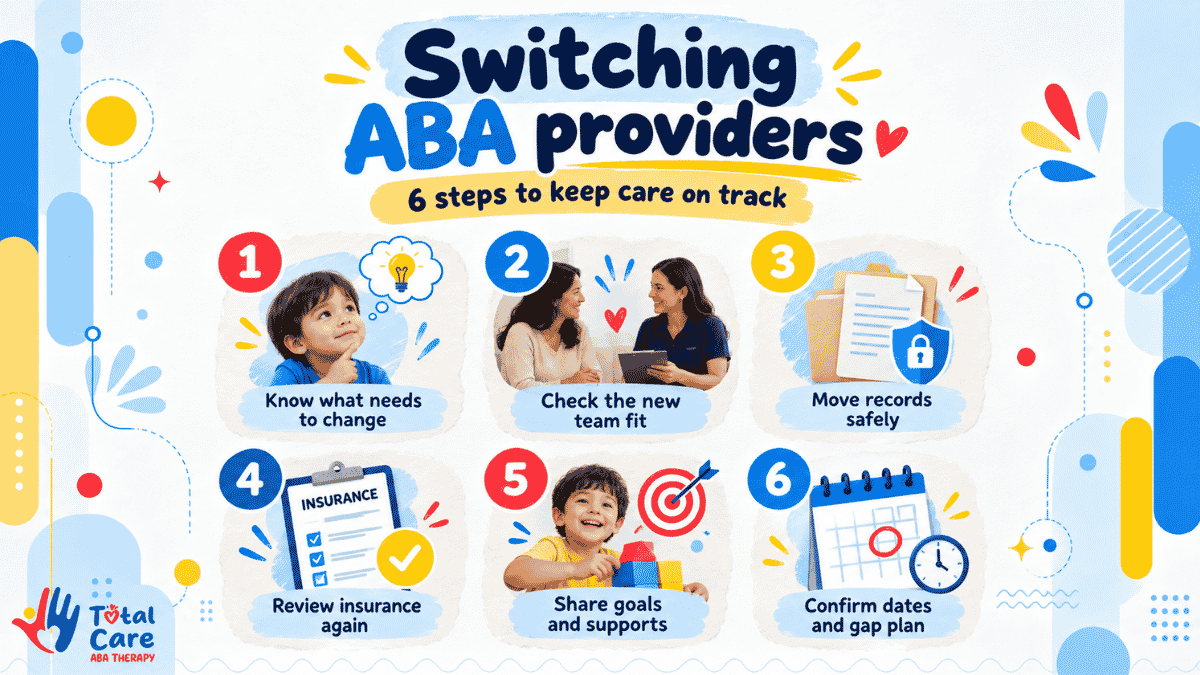
Your ABA provider transfer checklist
A transfer involves your family, both providers, and your insurer when insurance covers treatment. A contact name and follow-up date beside each task can help you track unanswered questions.
Some tasks happen together. For example, the new provider may need records before completing an assessment or submitting an insurance request.
1. Identify the change your family needs
A different therapist within the same company and a transfer to another company involve different steps. Your starting point is what needs to change, such as appointment times, communication, or where therapy happens.
A scheduling concern might lead to another appointment time or staff assignment. An internal change is an option, but your family can explore other companies without requesting a reassignment first.
If progress concerns prompted the change, our ABA progress review checklist can help you prepare questions about goals, measured changes, and your child’s comfort during sessions.
2. Confirm what the new provider can offer
The new intake team needs basic information about your child and your schedule. Your ZIP code, child’s age, insurance plan, preferred setting, and available times give the team a starting point.
Your questions can cover:
- Eligibility: Does the provider serve your child’s age group and location?
- Scheduling: Which appointment times and settings are available?
- Documents: What does the team need before reviewing the transfer?
- Next appointment: Is the opening for intake, an assessment, or treatment?
An assessment opening next week does not confirm a treatment opening the following week. That distinction can prevent an unexpected break between providers.
We offer ABA at home, in school, and in clinics. Our locations and service areas can help you begin checking local options; the available setting and schedule still need confirmation for your child.
3. Arrange the records request
The new provider’s document list gives you a starting point for transferring ABA therapy records. Requested information may include:
- Diagnostic reports and previous assessments.
- Current treatment goals and plans.
- Recent progress reports and supporting data.
- A service summary and relevant safety or communication supports.
The current provider can explain its release process. The new team should supply the correct recipient and a secure delivery method. Private records belong in that process, rather than a general website message box.
The federal health privacy law known as HIPAA generally gives patients and their authorized representatives access to medical records held by covered providers. A parent’s authority to access a child’s records has exceptions. The records team can explain the applicable requirements and any permission forms.
A submitted request does not confirm delivery. Your tracker should show when the new team received each document, so missing items receive follow-up.
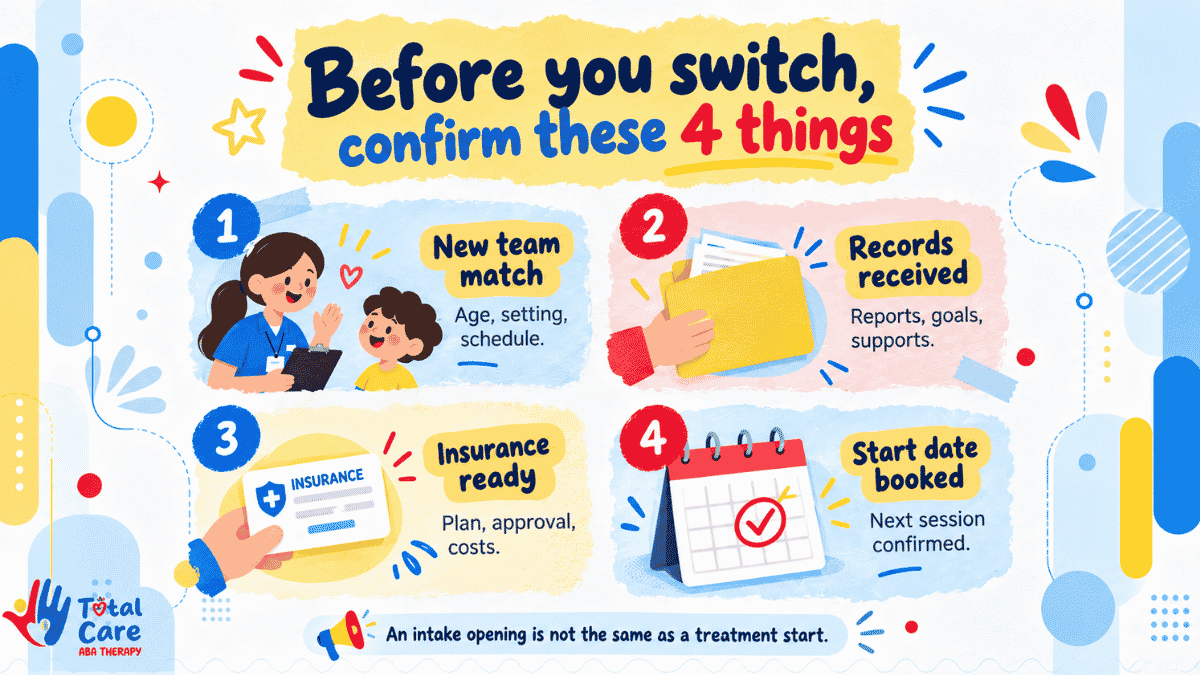
4. Check insurance before finalizing dates
Insurance needs another review when switching ABA providers. A company accepting your insurer’s name does not establish that it participates in your specific plan.
A benefit check reviews coverage and possible costs. Prior authorization is a separate decision about whether a service is medically necessary. Some plans require it before care begins, and authorization does not guarantee payment.
Your insurer and both providers should address:
- Network status: Whether the new provider participates in your exact plan.
- Approval: Whether a new or revised authorization is required and who submits it.
- Current services: Whether the existing approval needs an update or end date.
- Service details: Which dates, hours, and settings an approval covers.
- Assessment: Whether assessment and treatment require separate approvals.
- Family costs: Any deductible, copayment, or coinsurance that could apply.
Any proposed overlap between providers needs the insurer’s review. An existing approval should not be treated as permission for another company to deliver the same services.
Through our ABA benefit checks, we review coverage, potential out-of-pocket costs, and referral or authorization requirements.
5. Coordinate the clinical handoff
A clinical handoff helps the new team understand the care behind the records. Your child’s current and incoming Board Certified Behavior Analysts (BCBAs) can discuss goals and support needs through the appropriate consent process.
The BACB’s continuity-of-services toolkit includes transferring documentation and consulting with the next provider when needed. A joint meeting may not be possible, so another agreed method of communication may be necessary.
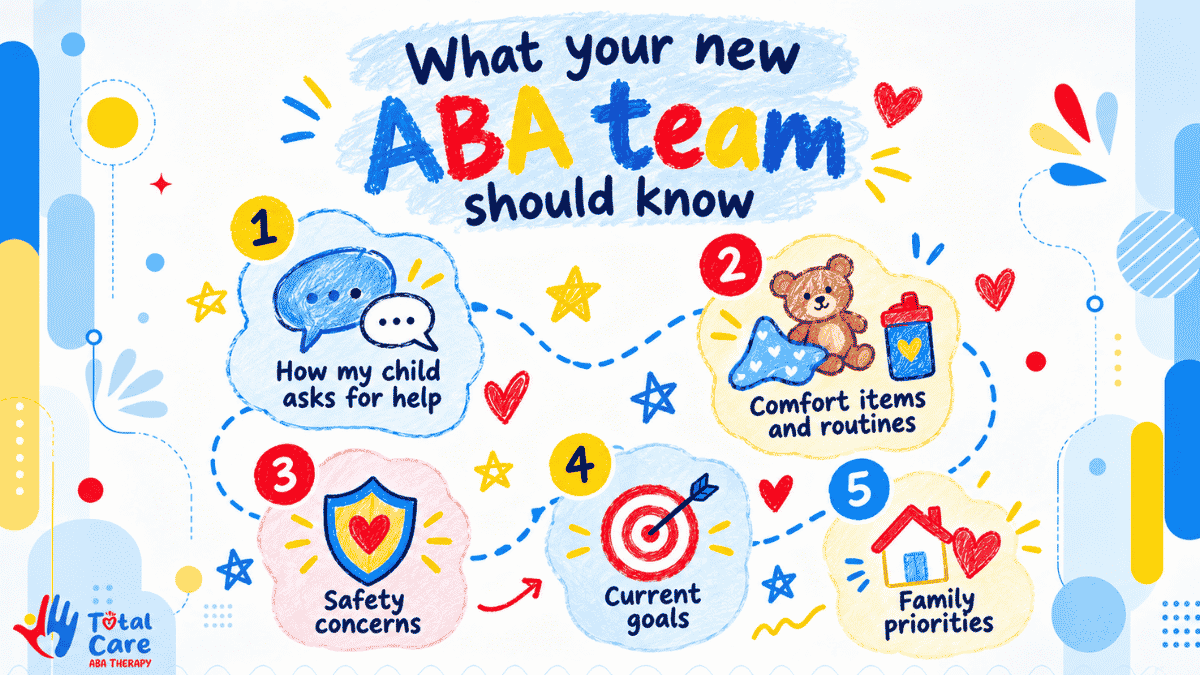
Your child’s everyday needs belong in the handoff
Your observations add context that reports may miss. For example, your child might use a picture card to request a break. The new therapist needs to recognize that request from the beginning.
A handoff conversation can cover:
- Your child’s words, gestures, pictures, or communication device.
- Current goals and skills that still need support.
- Safety concerns and existing response plans.
- Activities, routines, and items that help your child feel comfortable.
- Your family’s priorities for the next stage of care.
During our initial ABA assessment, we review existing evaluations, observe your child, and discuss routines and concerns with caregivers. A BCBA uses that information to develop individual treatment goals.
6. Confirm dates and prepare for any gap
Written confirmation should distinguish scheduled appointments from requested dates. Your family should also review the current provider’s service agreement for notice terms.
BACB standards for transitioning services call for a written plan naming target dates, transition activities, and responsible people. Your child’s clinicians can explain how they will coordinate those steps.
If a gap is expected, the plan should address:
- The last scheduled session with the current provider.
- The next confirmed appointment with the new team.
- Appropriate interim support and whom to contact with concerns.
- Any unresolved records, staffing, or insurance tasks.
A scheduling delay should never be a reason to remain in unsafe care. Safety concerns need attention when they arise.
FAQs about switching ABA providers
Can an unpaid bill prevent access to my child’s records?
A HIPAA-covered provider cannot deny access solely because treatment bills remain unpaid. Permitted copying or mailing charges are separate. Your authority to access your child’s records and applicable exceptions still apply.
What if my child’s records contain an error?
You can request a correction from the provider holding the record. The provider must respond but may deny the request. If that happens, you can submit a statement of disagreement for inclusion in the record.
Does changing ABA providers require a new autism diagnosis?
A provider change alone does not establish that another diagnostic evaluation is necessary. The new team and insurer can explain whether existing reports meet their requirements. Our ABA assessment evaluates treatment needs; it does not diagnose autism.
Plan your child’s move to a new ABA team
A provider change should account for the support your child receives now and what they need next. Coordination between teams helps carry that information into the next stage of care.
At Total Care ABA, we can review your benefits and explain our assessment process. Our intake team can answer questions about services in your location and the next enrollment steps.