Gestalt language processing and ABA communication goals
Gestalt language processing describes repeated phrases. Evidence helps parents weigh communication support options.

Gestalt language processing and ABA communication goals
Key Points:
- Gestalt language processing does not provide a proven sequence for setting ABA communication goals.
- Progress can include expressing a need more independently while a child continues using scripts.
- A speech-language pathologist can assess language skills, while an ABA team supports communication during daily activities.
Gestalt language processing (GLP) is a term some people use when a child relies on remembered phrases, song lines, or scripts. A child described as a gestalt language processor might repeat a cartoon line during dinner or reuse a familiar question to request a snack.
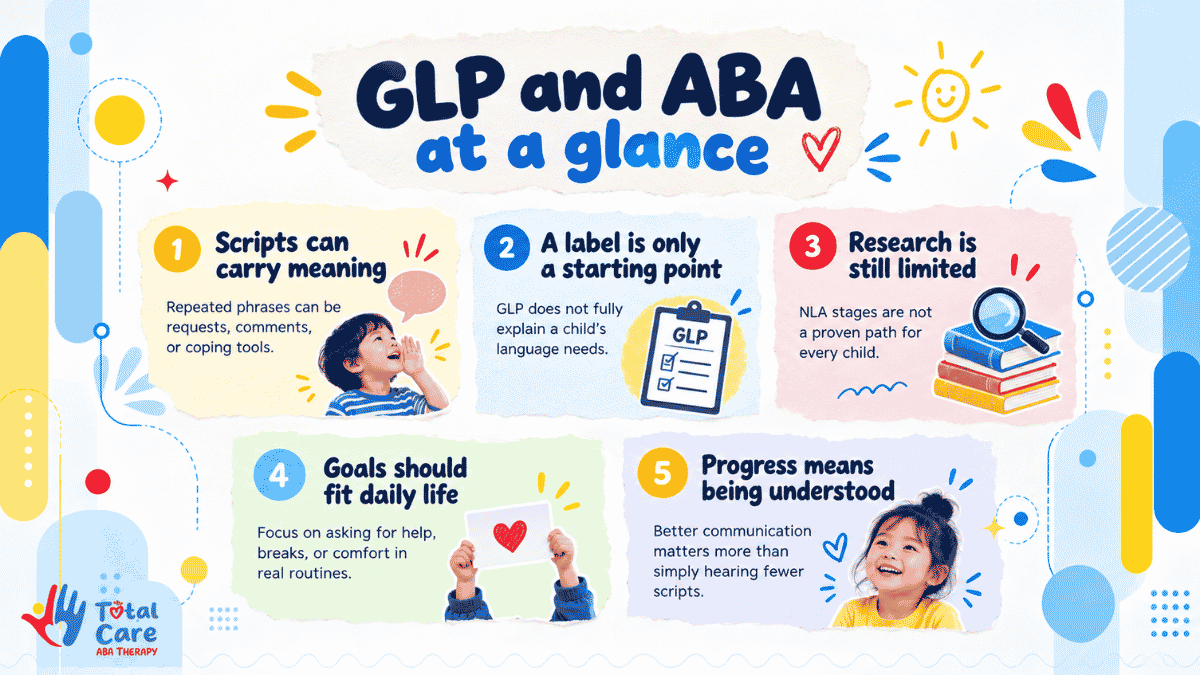
A script can carry a message even when adults do not recognize its meaning. The GLP label alone cannot explain how that child learns language or which support they need.
What does the gestalt language processor label mean?
The label describes a proposed way of learning language through larger phrases. Some explanations compare analytic vs gestalt language as learning single words first versus starting with whole phrases.
Children can use individual words, remembered phrases, and original sentences together. A critical analysis of GLP and language development found insufficient evidence for treating these descriptions as separate clinical groups. A child's repeated speech does not establish a fixed learning style.
The practical concern is whether your child can communicate what they want, understand others, and take part in daily life. Those needs deserve attention even when professionals use different terms to describe them.
What does research show about natural language acquisition?
Natural language acquisition (NLA) is a proposed framework linked to GLP. It describes stages that move from remembered phrases toward smaller word combinations and original sentences.
A systematic review published in 2025 found no research studies evaluating the effectiveness of GLP/NLA interventions. The proposed stages should therefore not serve as a proven sequence that every child must complete.
Research limits around NLA for autism do not erase the value of listening to children or respecting their speech. Those practices can support care without proving the full NLA framework. A communication plan still needs goals based on the child's assessed skills and needs.
How repeated phrases can reveal communication needs
Delayed echolalia means repeating language heard earlier, sometimes hours or days before. Scripting can include familiar lines from conversations, books, songs, or shows.
Repeated speech may help a child communicate, process language, or manage emotions. The American Speech-Language-Hearing Association recognizes these functions of echolalia. Harmless repetition does not automatically need treatment.
For example, a child might say “Ready, set, go!” beside a closed door. The phrase could relate to going outside, recalling a game, or enjoying the sound. The words alone cannot settle the meaning.
A few notes can help the care team understand what happened:
- The exact phrase your child used.
- The activity immediately before it.
- Any pointing, movement, or facial expression.
- The adult's response and what your child did next.
A note such as “said ‘Ready, set, go!’ while bringing shoes to the door” gives more information than “scripted three times.” The purpose is to understand communication without assigning an NLA stage.

How ABA can support communication alongside speech therapy
ABA can address practical communication during daily routines. Speech-language assessment examines how a child understands and uses language, including repeated speech. The two services have different roles, and ABA does not replace speech therapy.
At Total Care ABA, our initial assessment includes reviewing existing evaluations, observing your child, and talking with caregivers about routines and concerns. Our BCBAs use those findings to develop individual goals.
For a child who uses scripts, possible goals might include:
- Requesting help when a toy will not work.
- Asking for a break during an activity.
- Refusing an unwanted item.
- Telling another person about discomfort.
The goal should describe what the child can communicate and how independently they can do it. A familiar phrase may already communicate a request successfully. Support can build on that ability and address situations where others still struggle to understand.
Our home-based ABA services provide opportunities to practice assessed goals during familiar activities. A request for help, for example, can occur during play or while getting dressed. Our parent training also covers communication support during daily routines.
When a child receives multiple services, families can request shared goals and consistent responses from providers. Families managing several therapies can also read about coordinating speech and ABA goals at home.
What should parents ask about a proposed communication plan?
A communication plan should explain what the child needs help doing, why the team chose that goal, and how the team will assess progress.
Parents can bring these questions to a care meeting:
- “What can my child already communicate through their scripts?”
- “Which everyday situation does this goal address?”
- “What evidence supports the teaching method?”
- “How will you respond when my child communicates refusal or discomfort?”
- “How will we know the skill works outside therapy?”
Progress might mean that more people understand a request or that your child needs fewer reminders to express it. A lower number of scripts, by itself, does not show whether communication has improved.

FAQs about gestalt language processing
Can a child use AAC while still using scripts?
A child can use augmentative and alternative communication (AAC) alongside spoken phrases. AAC includes tools such as communication boards and speech-generating devices. There are no required language milestones before starting AAC. An assessment can help identify suitable options.
Does the GLP label tell me my child's intelligence?
The GLP label cannot measure intelligence. Spoken language alone does not show everything a child understands. Concerns about learning require an appropriate assessment that considers the child's abilities and communication needs.
Should we stop using our home language because our child scripts?
Families do not need to stop using a home language because a child scripts. Research does not show that bilingual exposure harms autistic children's language development. A speech-language assessment should account for the languages the child hears and uses.
Build communication goals around your child's daily needs
Your child's repeated phrases deserve attention for what they may express. Assessment and everyday observations can help identify where communication already works and where additional support could help.
At Total Care ABA, we develop ABA plans around each child's assessed skills and family priorities. Our team can talk with you about communication concerns, explain our services, and outline the assessment process.