
ABA Life Skills Beyond the Therapy Session: Building Daily Independence at Home and in the Community
ABA life skills explain how daily routines like dressing, meals, and errands build independence beyond sessions. See simple plans that support carryover daily.

ABA Life Skills Beyond the Therapy Session: Building Daily Independence at Home and in the Community
Key Points:
- ABA life skills help children build independence in daily routines like dressing, eating, and running errands.
- Skills move from therapy to home through simple plans, consistent prompting, and short, focused practice.
- Real-life carryover is supported by caregiver coaching, community outings, and regular check-ins.
Many families see gains in therapy, then feel lost when skills stall at home. Daily tasks like brushing teeth, getting dressed, or ordering food can still feel like a tug-of-war, even after months of work.
ABA life skills focus on turning those moments into teachable routines that match what your child already does in session, so progress does not depend on a therapy room alone. When you understand how to bring therapy strategies into real routines, you gain a clear, repeatable way to help your child grow at home and in the community.

How Do ABA Life Skills Move From Session to Home?
Therapists often introduce new skills in structured sessions first, then hand them off to caregivers. A strong session-to-home plan turns each new target into a simple “recipe” you can follow between visits so your child does not lose momentum.
Many children receive limited hours of behavioral therapy, and one survey found that only about 43% of autistic children had behavioral therapy in a given year, while nearly one-third received no treatment at all.
A typical handoff for ABA life skills should include:
- Goal description: Clear wording about the skill, such as “wash hands for 20 seconds using soap, then dry,” matched to the daily living skills your BCBA is teaching.
- Step list: Short, numbered steps that match what the therapist taught in session.
- Prompt plan: What kind of help you give first (gesture, model, hand-over-hand) and what you avoid.
- Reinforcer ideas: Short rewards your child enjoys after doing the skill or a step correctly.
- Stop rules: Signs that tell you to pause or shorten practice, like rising frustration or sensory overload.
A recent parent training study found that structured coaching led to improvements in adaptive behavior, including daily living skills, compared with parent education alone. When your BCBA or RBT sends home a plan, ask for examples of daily living skills autism targets that are ready for you to run independently, and which ones still need more modeling in session.
You can request a one-page “home run sheet” for each new skill that answers:
- When to practice it during the week.
- Which prompts to start with and how many tries you should aim for.
- What a good session looks like and when to stop for the day.
Where Do Daily Living Skills Fit Into Your Child’s Day?
Life skills in autism grow faster when they “live” in real routines rather than in added drills. Routine anchors help everyone remember what to practice without adding extra tasks to an already busy day.
Many families use four anchors: morning, meals, errands, and bedtime. A review of interventions for daily living skills found that structured teaching of personal care, chores, and money management can meaningfully improve independence in autistic children.
You can map skills across the day like this:
- Morning: Dressing, toothbrushing, packing backpack, checking a simple visual schedule.
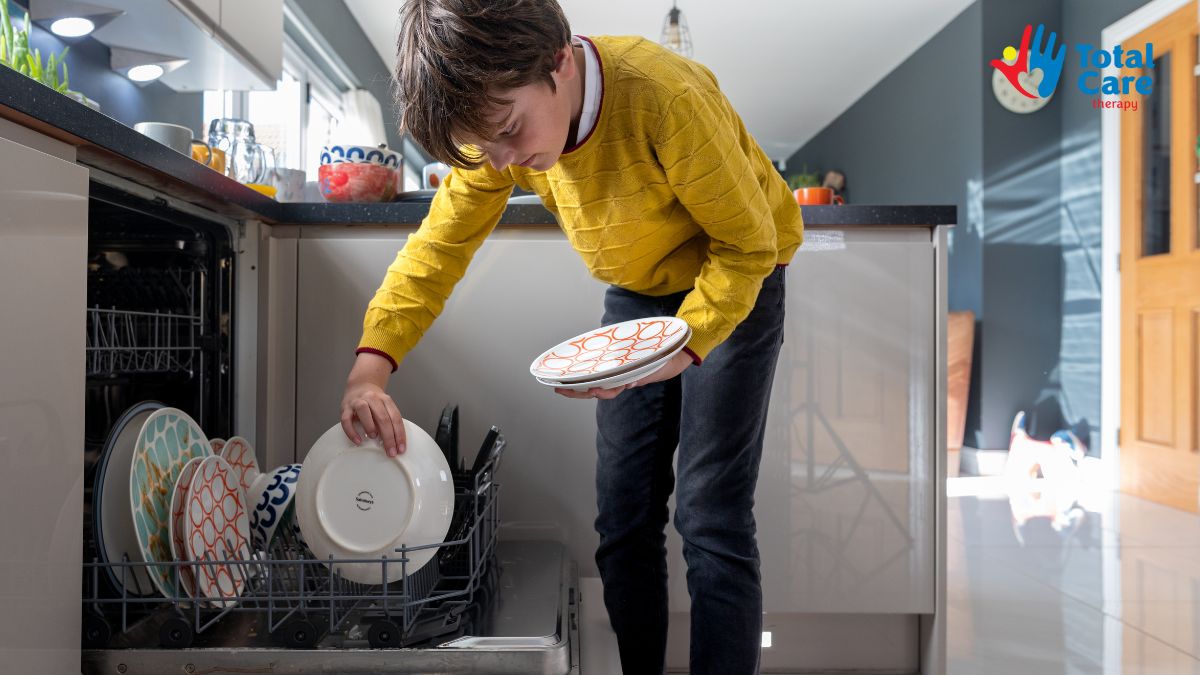
- Mealtime: Washing hands, carrying plate to the table, using utensils, clearing dishes.
- Community errands: Walking next to an adult, staying in a cart, choosing one item, waiting in line.
- Bedtime: Bath steps, putting on pajamas, choosing a book, turning off lights.
A simple two-week practice plan keeps the focus tight and realistic for independence training ABA at home. Building it into in-home ABA therapy routines makes practice easier to sustain.
Week 1 sample plan
- Morning anchor: Focus on one dressing step (pulling up pants, putting arms in sleeves).
- Mealtime anchor: Practice bringing the plate to the table and sitting until a short timer ends.
- Errand anchor: During one short store trip, practice holding the cart handle from the car to one aisle.
- Bedtime anchor: Practice putting dirty clothes in the hamper every night.
Week 2 sample plan
- Add a second step to each anchor only if Week 1 went smoothly at least three days.
- Rotate focus so the “hardest” skill shows up on days when adults have more time.
- Keep one “easy win” skill in each routine so your child experiences success often.
At the bottom of the schedule, leave space for notes like “rough morning,” “forgot store practice,” or “great success at grandma’s house.” That context helps your team adjust the plan.
What Is the Prompting and Fading Plan?
Prompts bridge the gap between “I cannot do this yet” and “I can do this on my own.” In ABA programs focused on functional life skills, a clear prompting plan protects independence by ensuring help gradually fades rather than lingering forever.
Parent-mediated interventions show that when caregivers use structured prompting and reinforcement, daily living skills improve, and those gains can hold after the formal program ends.
Therapists usually choose between two main prompting patterns:
- Most-to-least prompting: Start with strong support (hand-over-hand) and fade to lighter help over time.
- Least-to-most prompting: Start with a wait, then add visual, gesture, or verbal prompts only if needed.
A practical fading plan for adaptive skills ABA therapy might look like this:
- Define independence: Decide what counts as “independent” for the skill, such as brushing teeth with only a visual schedule.
- Pick a starting prompt: Choose the least help that still lets your child succeed most of the time.
- Set a fade rule: For example, “After three days at 80% success, drop from hand-over-hand to wrist guidance.”
- Plan for errors: Decide what to do if your child hesitates or makes a mistake, such as stepping back up one prompt level for a few trials.
- Review weekly: Share quick home notes with your BCBA so the clinic and home plans match.
Simple reminders keep you from over-helping. You might keep a sticky note near the sink with a prompt ladder: “Wait → point → model → gentle touch.” That visual keeps the focus on growing independence instead of jumping straight to full help at the first sign of struggle.
How Can Families Practice Life Skills in the Community?
Skills feel different once you add noise, crowds, and new expectations. Community practice gives your child a safe way to use autism self care and safety skills outside the house in small, planned steps.
Long-term studies indicate that autistic adults often face lower rates of competitive employment and independent living compared with peers who do not have disabilities, which highlights the need for early real-world practice.
A short community outing can focus on just one or two targets instead of everything at once. For example:
- Grocery store trip: Holding the cart, placing one item in the cart, standing in a “feet on the line” spot at checkout.
- Playground visit: Waiting for a turn on the slide, following a “2 more minutes” timer, walking back to the car.
- Restaurant visit: Choosing from two menu options, handing the menu back, using napkins.
A simple “community generalization checklist” might include:
- Skill: What you want to practice today (for example, staying with the cart).
- Setting: Where it happens (store, park, restaurant).
- Prompt level: How much help you plan to give at first.
- Reinforcer: What your child earns for trying (sticker, snack, extra playground time).
- Safety rules: Non-negotiables like “hold hands in the parking lot” or “stay where you can see the adult.”
For some families, it feels easier to start with “preview visits,” such as walking one aisle and leaving, before expecting complex orders or longer waits. You can share photos of the store or restaurant with your child beforehand so it feels more familiar. Over time, these short, low-pressure outings help generalize ABA life skills beyond session walls.

How Do You Keep Skills Strong Over Time?
Once a skill is mastered, the goal shifts from learning to keeping it going in real life. Maintenance plans treat independence like a regular habit, not a one-time milestone.
Maintenance for functional skills ABA often includes:
- Reduced but steady practice: For example, running the full toothbrushing routine twice a week instead of daily trials.
- Natural reinforcement: Linking the skill to real outcomes, such as “When you shower, you can choose your own clothes for the day.”
- Mixed practice: Combining mastered skills with one current target to make practice feel efficient.
You can build a monthly “skills check” routine:
- Pick three mastered skills across different routines, like handwashing, simple snack prep, and putting laundry away.
- Run each skill once or twice in real time without prompts to see how your child does.
- Mark each skill as “solid,” “needs a prompt,” or “slipped,” and share the pattern with your therapist.
If a skill starts slipping, you simply re-enter a short teaching phase with more prompts for a week or two, then fade again. That cycle is normal and does not erase past progress.
How Can You Troubleshoot ABA Life Skills Challenges?
Even with a strong plan, challenges happen. Three common problems are prompt dependence, skills that only show up at home, and weekend backslides. Clear troubleshooting steps help you adjust without making you feel like everything failed.
Studies on daily living skills training show that even brief, focused programs can improve task completion when adults adjust support based on performance instead of guessing.
Prompt dependence shows up when your child waits for help before doing anything. To respond, you can:
- Shorten your instructions and use more pauses so your child has time to start.
- Lower the prompt level slowly, one step at a time, while maintaining a strong level of reinforcement.
- Reward initiative even if the skill is not perfect yet.
Skills that work only at home often need a clear generalization plan tied to ABA therapy goals:
- Change one thing at a time, such as moving handwashing from the bathroom sink to the kitchen sink.
- Practice with a new person who follows the same steps and prompts.
- Use portable supports, like a small visual card with the skill steps that travels in a bag.
Weekend or holiday drops happen when routines change. To protect skills:
- Choose one “non-negotiable” skill to keep running every weekend, such as getting dressed before screen time.
- Run micro-sessions lasting only 1 or 2 minutes instead of full routines.
- Reset on Monday with an easier version of the skill if the weekend was intense, then build back up.
A very simple data sheet can make troubleshooting easier:
- Columns: Date, routine (morning, meals, errands, bedtime), skill, prompt level, success score (0–2), brief note.
- Use: Glance at patterns, such as skills that work on weekdays but fall apart on Saturdays.
Sharing these notes with your BCBA or RBT turns your home observations into concrete information that can guide the next round of changes.

Frequently Asked Questions
At what age should we start teaching life skills with ABA?
ABA-based life skills teaching should start in the preschool years, as soon as your child can participate in small routine steps. Early actions, such as handwashing or cleanup, lay a foundation. Starting young supports long-term outcomes by strengthening adaptive skills.
How many minutes per day should we practice life skills at home?
Five to ten minutes of life skills practice during daily routines is usually effective. Pairing two or three routines with targeted skills each day creates multiple learning opportunities without overwhelming your child. Short, frequent practice fits naturally into family life and supports steady progress.
Can siblings help with ABA life skills practice?
Siblings can support ABA life skills practice by modeling, encouraging, and assisting with routines when guided by adults. Clear roles and consistent language help the skill feel predictable. Involvement builds empathy and teamwork but should not replace adult-led instruction or prompting.
Strengthen Life Skills Independence With Personalized Support
Daily independence does not grow from clinic work alone. Real change happens when life skills become part of how your family does mornings, meals, errands, and bedtime, day after day.
Families can access ABA life skills training in Colorado, New Mexico, Tennessee, Indiana, Georgia, Arizona, North Carolina, Maine, and Utah to turn everyday routines into steady practice that matches what happens in session. Visit our locations page to find services near you.
At Total Care ABA, the team focuses on clear handoffs from therapy to home, practical caregiver coaching, and life skills plans that include real community settings. Programs emphasize measurable progress on self-care, home routines, and community participation rather than abstract goals.
If you are ready to grow your child’s independence step by step, contact us today to learn how services in your state can support your family’s next steps.