7 Documents parents should bring to an ABA behavioral assessment in Scottsdale
An ABA behavioral assessment in Scottsdale needs records that show skills, routines, and safety needs. Pack these 7 parent documents before intake.

7 Documents parents should bring to an ABA behavioral assessment in Scottsdale
Key Points:
- An ABA behavioral assessment in Scottsdale works best when parents bring records that show diagnosis, health needs, school history, therapy progress, behavior patterns, routines, and goals.
- These documents help the BCBA understand the child across settings.
- Missing files may delay authorization, but available records still support intake.
Your upcoming appointment for an ABA behavioral assessment in Scottsdale will run much more smoothly with the right paperwork ready. Parents need to bring records showing clear details. These files include a clinical diagnosis, medical needs, school history, and past therapies. You should also track current behavior patterns, daily routines, and insurance paperwork.
Gathering these items helps the visit run efficiently. This ABA initial assessment does not provide an autism diagnosis. Instead, the process helps a Board Certified Behavior Analyst (BCBA) build an effective behavior plan. Knowing what to pack makes this preparation simple. How do you start preparing?

ABA behavioral assessment in Scottsdale: What these documents help the BCBA see
A BCBA needs more than one appointment snapshot. During an initial assessment, the process may include reviewing prior evaluations, observing the child, using standardized assessments, completing a functional behavior assessment, and talking with caregivers.
Families starting ABA therapy in Scottsdale may send records before the first visit. Some Arizona Health Care Cost Containment System (AHCCCS) managed plans may require prior authorization for ABA services.
1. Bring the autism diagnosis or developmental evaluation report
Bring the full diagnostic report. A short doctor's note is not enough. Useful details include the diagnosis date and the evaluator's name. The report should list developmental history, adaptive skills, and clinical recommendations. Did your child receive a diagnosis outside of Scottsdale? Bring that original report to the clinic anyway.
An ABA assessment does not replace a diagnostic evaluation. The Centers for Disease Control and Prevention explains that autism screening tools do not diagnose autism. A positive screen should lead to a fuller assessment when concerns are present.

2. Bring your insurance card, referral, and prior authorization details
Gather your insurance card, referral, and prior authorization details. You should also include your Arizona Health Care Cost Containment System paperwork. Scottsdale families using public or private insurance have plan-specific requirements.
Arizona Complete Health states that some behavioral services require prior authorization. The provider works directly with the health plan on that process. Parents searching for an ABA therapy evaluation near me should ask about required records early. This step prevents unexpected out-of-pocket costs later.
Common funding plans in Arizona include:
- Private health insurance plans
- Public state health options
- KidsCare program coverage
ABA benefit checks confirm what your plan covers.
3. Bring medical history, medication lists, and safety notes
Medical records help the BCBA see health factors that may affect routines. Bring pediatrician notes, current medications, allergies, seizure history, sleep concerns, feeding concerns, hearing or vision notes, and safety risks. Pain, hunger, sleep loss, medication changes, or sensory needs may affect how a child responds during the day.
Scottsdale parents should include local provider contact details when care coordination may be needed. Useful safety notes may include:
- Elopement near parking lots
- Unsafe climbing
- Choking risks
- Self-injury
- Severe sleep disruption

4. Bring school records, IEPs, 504 plans, and teacher notes
Bring your child's Individualized Education Program records. Include 504 plans, behavior intervention plans, and school evaluations. Teacher notes and classroom communication logs are also valuable. School records help a practitioner see when specific behaviors appear. They might occur during transitions, group work, or peer play. Academic tasks can also trigger responses.
Scottsdale area parents should bring documents from various settings:
- Local public schools
- Private academies
- Early intervention programs
These papers track classroom progress over time. Sharing school records supports ABA school support and creates consistency for your child. The clinician looks at the whole day. Classroom data tells a major part of the story.
Scottsdale parents often have records split across pediatricians, schools, and therapy providers. At Total Care ABA, we can help you sort which documents to send first before the initial assessment. Our team wants the clearest picture of your child’s needs. We make organizing this paperwork simple. You can focus on your family while we handle the logistics.
5. Bring speech, OT, counseling, or prior ABA therapy reports
Briefly look at prior treatment notes. Bring speech therapy goals, occupational therapy notes, and feeding therapy reports. Include counseling notes or prior behavior records. Discharge summaries or progress reports are highly useful. This information prevents overlapping interventions. It keeps therapy efficient.
Useful therapy documents include:
- Speech therapy progress reports
- Occupational therapy sensory plans
- Past behavioral progress data
Coordinating with previous providers supports clinical consistency. These files show which prompts, reinforcers, and communication systems helped your child progress. Reviewing them prevents repeating goals your child already mastered. Your child has already worked hard on those skills. The new plan should build on that foundation instead of starting over.
6. Bring behavior notes, short videos, and ABC patterns
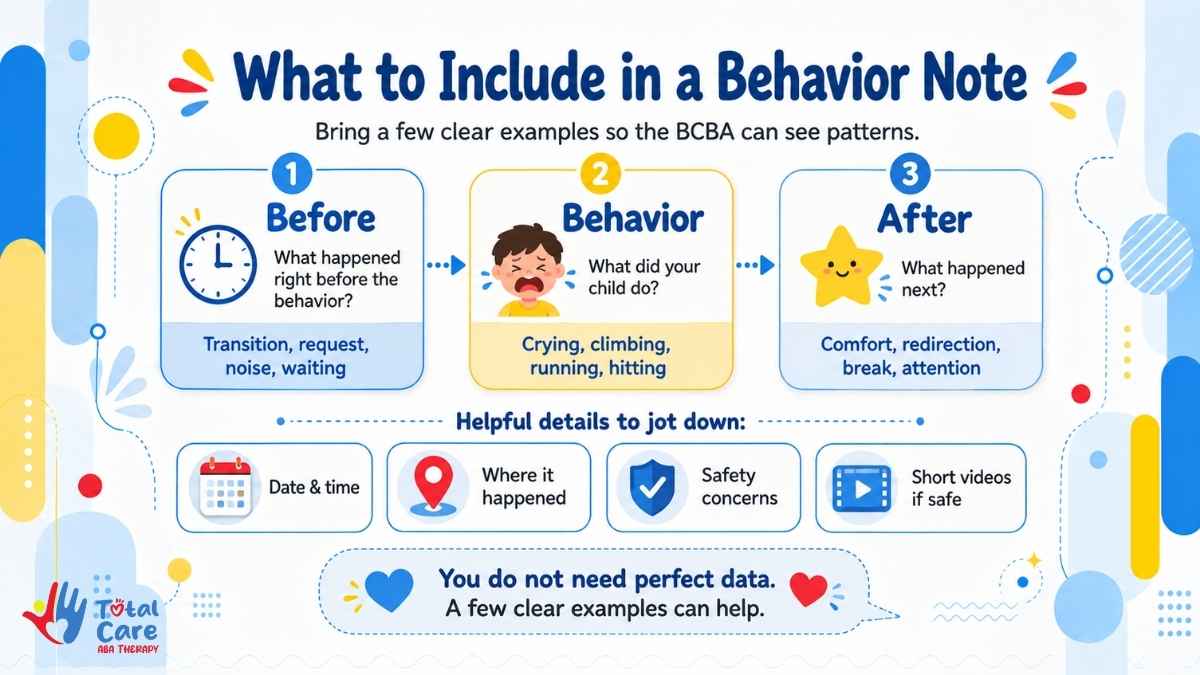
Parent notes can turn daily stress into useful assessment details. Bring a behavior log with the date, time, location, what happened before the behavior, what the behavior looked like, and what happened after. Many ABA teams call this an antecedent, behavior, consequence pattern.
Parents do not need perfect data. A few clear examples from a Scottsdale grocery trip, school drop-off, bedtime, or doctor visit can help. Short videos can help when they are safe, respectful, and show a pattern that is hard to explain.
Safety comes first. Stop recording if your child needs help. Include notes about elopement, unsafe climbing, aggression, self-injury, choking risks, or severe sleep disruption.
How ABA behavioral assessment in Scottsdale notes show patterns
A functional behavior assessment looks for the purpose of a behavior, not blame. The National Professional Development Center brief states that data collection is a key part of functional behavior assessment and that the process helps teams understand the function of interfering behavior.
7. Bring daily routine notes, communication tools, and family goals
Bring notes about morning routines, meals, toileting, and bedtime. Track play skills, errands, sibling interactions, and community outings. Bring Augmentative and Alternative Communication device details or picture cards. Note favorite items, sensory supports, or comfort items. List three parent goals in plain language. Family goals and preferences are always included in the treatment plan.
Practical Scottsdale examples include:
- Smoother school drop-off routines
- Safer parking lot transitions near shopping centers
- Easier family mealtimes at home
- Clearer communication requests at home
ABA parent coaching keeps your family's priorities at the core focus of care. What matters most to your household daily? Tell the clinician directly during your meeting.

FAQs about ABA behavioral assessment in Scottsdale
Can my child still have the assessment if I do not have every document?
Yes. Bring what you currently have. Tell the intake team what is missing. The clinical team can still interview you, observe your child, and review available records. Missing insurance or diagnosis paperwork may delay official plan authorization. Send those files as soon as possible.
Should I bring videos of my child’s behavior?
Yes. Bring them if the videos are safe and brief. They should show a specific pattern you want the clinician to understand. A quick 30-second clip clarifies what happens right before and after a behavior. Never record during unsafe moments.
Is an ABA behavioral assessment the same as an autism diagnosis?
No, an ABA assessment does not diagnose autism. A licensed diagnostic provider handles diagnosis. The ABA assessment helps the BCBA understand current skills, behaviors, routines, and goals for an ABA treatment plan.
Prepare for the first assessment call
Scottsdale parents save time when diagnostic records, school reports, therapy notes, insurance details, and daily routine concerns are in one place. The BCBA uses those details to connect assessment findings to goals your child can practice. These goals apply at home, school, or the clinic.
At Total Care ABA, we support families in Scottsdale and across Arizona with benefit checks, initial assessments, parent training, home-based ABA, consultations, and school support. Call us today or submit the intake form. Our team will review your information, check your benefits, and help schedule the next step in the assessment.